With the development of science and technology, LED technology has also been rapidly developed. The cost is gradually reduced, coupled with the global trend of energy saving and emission reduction, LED lamps in the field from home decoration to outdoor municipal engineering and other fields have been widely used. Consumers and engineering projects in the choice of lamps, often only focus on price, emphasize the power supply used in LED lamps and LED chip quality, but often ignore the importance of color temperature in different use scenarios.
In fact, choosing the right color temperature of LED lamps and lanterns can not only enhance the texture of the project, but also optimize the lighting environment, making it more comfortable and reasonable.
Color temperature measures the color component of light, which theoretically represents the temperature change of light emitted by an ideal black-body as it is gradually heated from absolute zero (-273°C). As the black-body heats up, its light changes sequentially from black to red, yellow, white, and eventually blue light. The spectral component at a given temperature is called the color temperature in Kelvin (K).
When the color of a light source is the same as a black body at a specific temperature, we say that the light source has the color temperature for that temperature. For example, if the light from a 100-watt bulb matches a black-body at 2527°C, the color temperature of the bulb can be calculated by the formula (2527 + 273)K = 2800K.
The unit of color temperature is “K” (Kelvin), absolute zero is -273.15 ° C, equivalent to 0 K. Every 1 degree Celsius, the temperature increases by 1 K. In short, 0 ° C is equal to 273.15 K, 100 ° C is equal to 373.15 K. The color temperature of a light bulb can be calculated in descending order.
Color temperatures are red, orange, yellow, white, and blue, in descending order, until blue is the highest.
The common color temperatures of light sources in life
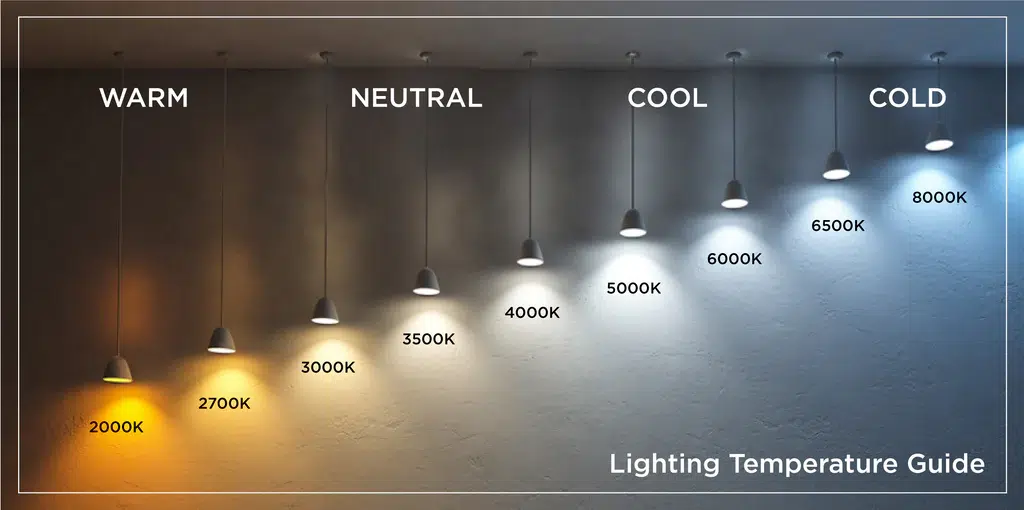
The color temperature of common light sources in life can be divided into the following categories, most of the LED lights on the market today cover these three categories of color temperature, each with its own unique characteristics:
Warm color temperature:
below 3500K, the color is reddish, giving people a warm, comfortable and stable feeling. LED lights with low color temperature can make red objects more vivid, commonly used in leisure places, such as bedrooms and cafes, to help people relax.
Neutral Color Temperature:
Color temperature between 3500K and 5000K is known as neutral color temperature. The light is soft, giving people a pleasant, refreshing and clean feeling, which can truly show the color of the object, suitable for offices, kitchens, shopping malls and other environments that require a better visual experience.
Cold color temperature:
color temperature above 5000K, also called cold light. The light is bluish, bright and calm, giving a sense of coldness and improving concentration. Cold color temperature is usually used in offices, hospitals and other places that require concentration. Light sources with high color temperature generally have higher luminous efficiency than those with low color temperature, but they are less suitable for home use.
Different color temperature of the LED lamp in the actual application of the performance of each characteristic, as shown in the figure below:
color temperature
After understanding the color temperature of LED lights, we also need to pay attention to the relationship between sunlight and color temperature in daily life, which often affects our choice of the right color temperature of the lamps.
As shown in the figure below, the relationship between sunlight and color temperature is shown visually.
color temperature
As can be seen from the above chart, the color temperature of the light source during the day is higher, which can stimulate the brain’s vitality; while the color temperature of the light source at dusk is lower, which is more conducive to relaxation and thinking. Thus, in a higher color temperature environment, the light is bright, clear, and keeps you focused, while in a lower color temperature light, the environment appears warmer, more soothing, and conducive to rest and contemplation.
Bedroom: as the main leisure space, the best color temperature for the bedroom is around 3000K. Such warm colors can create a relaxing and comfortable environment, which will help you fall asleep quickly.
Bathroom: as a relaxing space, the bathroom should not use too high color temperature lights, 3000K warm light or 4000-4500K neutral light is more appropriate. Bathrooms also need to use waterproof lamps, such as waterproof downlights, to avoid water vapor damage to the LED chip.
Dining Room: Low color temperature LED lights below 3500K are suitable. The reddish light enhances the color saturation of food and increases appetite. Modern linear chandeliers are recommended for dining room lighting.
Living room: As the main home activity area, the living room usually adopts a neutral color temperature of 4000-4500K. The light is soft and brings a pleasant, refreshing, clean and natural feeling, while still showing the true colors of the living room. This is the reason why most magnetic track lights on the European market choose a color temperature of 4000-4500K. The living room can also be matched with yellow floor lamps or table lamps to create a cozy atmosphere and make the lighting level richer.
Choosing the right color temperature can significantly enhance the interior decorative effect. Walls, floors, furniture and other factors should be considered according to the use of the room and its color scheme. In addition, special attention needs to be paid to avoid blue light hazards, especially for the elderly and children, who should try to choose low color temperature lighting to reduce its impact.
Commercial area
Hotel: As a place of rest for travelers, hotels need to create a warm, comfortable and friendly atmosphere. No matter what kind of star hotel, it should use 3000K warm color lighting to express a friendly and warm light environment. 3000K warm white LED spotlights, especially wall-washing fixtures, are very popular in the market, which can strengthen this atmosphere.
Office: Offices typically use cool white light in the 6000K-6500K range. Such color temperature helps to maintain focus, prevent dozing and enhance work efficiency. Therefore, most offices choose this color temperature range for their LED panel lights.
Schools (classrooms): A neutral color temperature of 4500K is usually chosen for classroom lighting. This light provides good illumination for comfort and avoids visual fatigue and brain fatigue caused by 6500K cold light, thus improving learning efficiency.
Hospitals: Wards and medical areas usually use 4000K-4500K LED lights. Wards need mood-stabilizing light, and the neutral color temperature of 4000K can bring a comfortable light environment and enhance the patient’s sense of well-being. At the same time, healthcare workers can stay focused and efficient in such a comfortable light environment.
Supermarket: Different areas in the supermarket are suitable for different color temperature combinations. A mix of 3000K, 4500K and 6500K color temperatures are generally used. For example, a low color temperature light source of 3000K is used in the meat section to make the meat look more vibrant. Fresh food area is suitable for 6500K high color temperature light source, can make the seafood in the reflection of crushed ice looks fresher.
Industrial area
Industrial areas mainly refer to areas where a lot of work is carried out, such as factories and warehouses, and usually require two types of lighting: general lighting and emergency lighting.
Outdoor Floodlights: Floodlights are widely used in outdoor lighting and are suitable for lighting of ballparks, squares and some municipal projects. In addition, in some lighting projects, it is also common to use red light, green light, blue light and other color floodlights. Among them, the stadium is particularly strict on the color temperature requirements of the floodlights, because the light can not affect the performance of the players. Usually, the color temperature of 4000-4500K is a more ideal choice, which can provide the right brightness and effectively reduce glare.
Landscape Lights: such as path lights, outdoor spotlights, etc., commonly used in gardens, path decorations, and local lighting. 3000K warm color light is the most effective in such scenarios, and it can create a warm, relaxing atmosphere, which is ideal for outdoor recreational places.
Conclusion
Color temperature plays a crucial role in the performance of LED lights, and choosing the right color temperature can significantly improve the lighting effect. As a professional LED lamp manufacturer, SUNME has successfully assisted customers to complete thousands of lighting projects. We always take a highly responsible attitude towards our customers and projects, providing the best lighting solutions and meeting all kinds of needs of our customers. If you have any questions about color temperature selection or luminaire selection, please feel free to contact us and we will provide you with professional advice.




 EN
EN DE
DE ES
ES PT
PT FR
FR RU
RU AR
AR IT
IT TR
TR FI
FI SV
SV HU
HU NL
NL