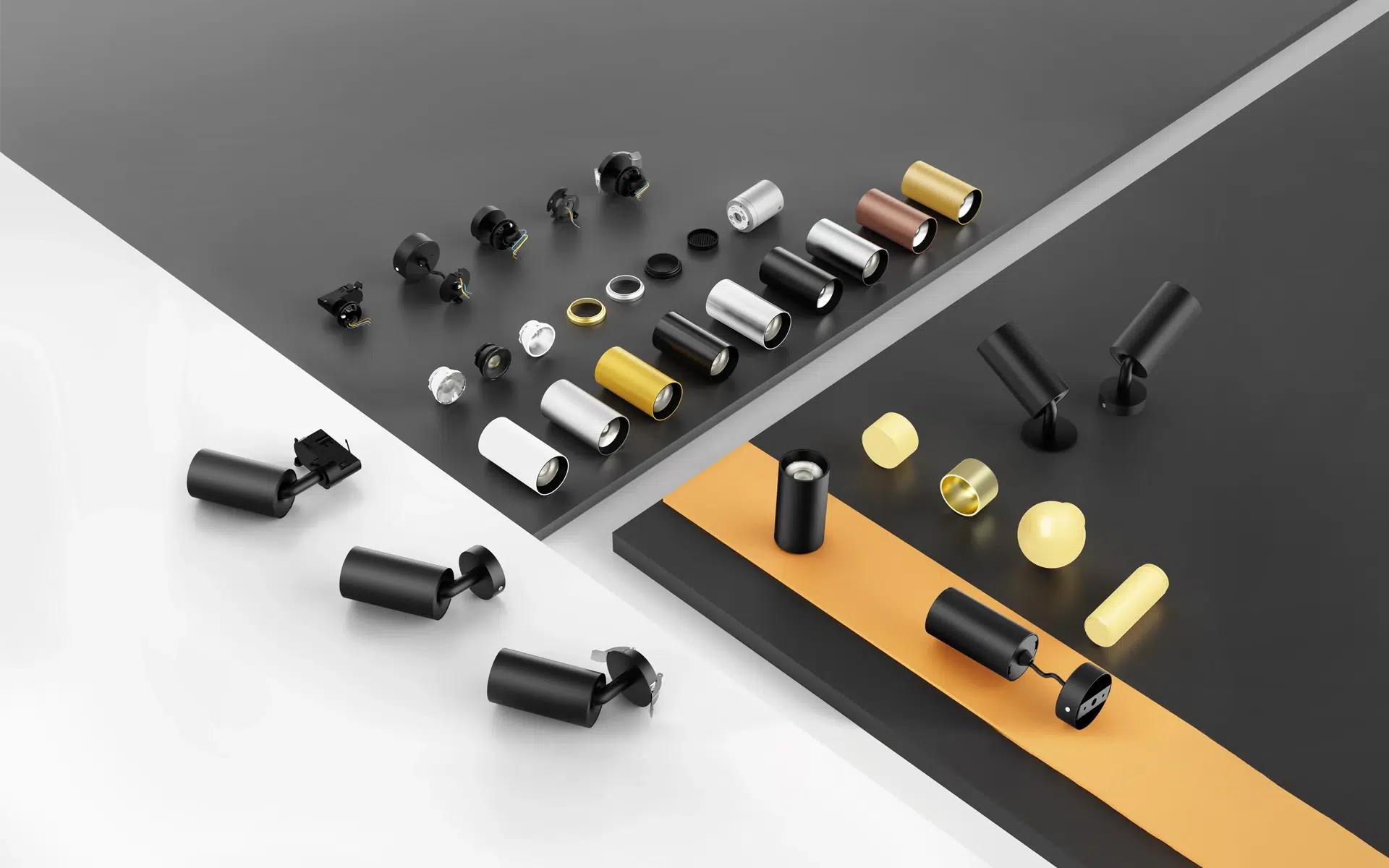
Featured image: a commercial track lighting head (Sunme CLIO series). The head is the easy part — the track system behind it decides what you can and cannot change later.
Track lighting looks like one of the simplest lines on a commercial lighting schedule. In practice it generates a disproportionate share of site problems: heads that arrive and do not fit the track, a recessed system ordered for a ceiling with no void, a dimming protocol chosen after the heads were produced, a tenant who changes the layout six months after handover and finds the system cannot change with it.
Almost all of them are decided at specification stage, not on site. This guide works through them in a project buyer’s order: track standard, track type, then circuits, dimming and heads.
Key takeaways
H, J and L track are three different standards; heads from one system do not fit another, and “almost fits” is a safety problem, not a workaround.
Choose the track type for the ceiling first — surface, recessed, monorail, bendable or magnetic — then choose heads.
Circuit count sets scene control; dimming is decided by each head’s driver, not by the track.
Beam angle, glare control and spare capacity decide whether the system still works after the layout changes.
First, the Compatibility Trap: H, J and L Track
The adapter on top of the head — not the head itself — is what locks you into one track standard.
North American track lighting grew up as three manufacturers’ proprietary systems, still named after their originators: H-type (Halo), J-type (Juno) and L-type (Lightolier). All three carry line voltage along what looks like the same aluminium channel. They are not the same: the contacts inside the channel differ in position, spacing and width, and each track head’s adapter matches one system only.
The practical consequences:
A J-type head will not mount into H-type track, or mounts without reliable contact — a loose contact means flicker, heat and, in the worst case, a head that drops.
No adapter safely converts between systems; a supplier who suggests otherwise is guessing with your project.
The trap exists within one system too: single- and multi-circuit versions of the same track family use different adapters.
European projects add a fourth world: the mainstream format there is 3-phase (three-circuit) track, whose heads and accessories do not cross over with H, J or L either.
The procurement rule is absolute: name the track system and circuit count in every specification, quotation and purchase order, and confirm the adapter type before production. Qualifying a new supplier? Order one length of track and one head first, and test the fit physically.
The Five Track Types, Compared
Most commercial ranges — SUNME’s track spotlight range included — are built around one or two of these formats. They differ less in light output than in what they demand from the ceiling and how they handle layout changes.
Surface-mounted track
Surface track with adjustable heads (TANGO series) — the default choice for finished ceilings and retrofit projects.
The default workhorse: track fixed directly to the ceiling or suspended on rods, with standard track lighting fixtures clicked in along its length.
Fördelar: installs on almost any finished ceiling; lowest installed cost of any track format; easy to extend and repair
Nackdelar: profile, feed boxes and adapters stay visible; the look is functional, not architectural
Bäst för: retail rollouts, supermarkets, showrooms, retrofits with closed ceilings. Most track lighting heads are designed for this format first; SUNME’s Clio series is typical.
Recessed track
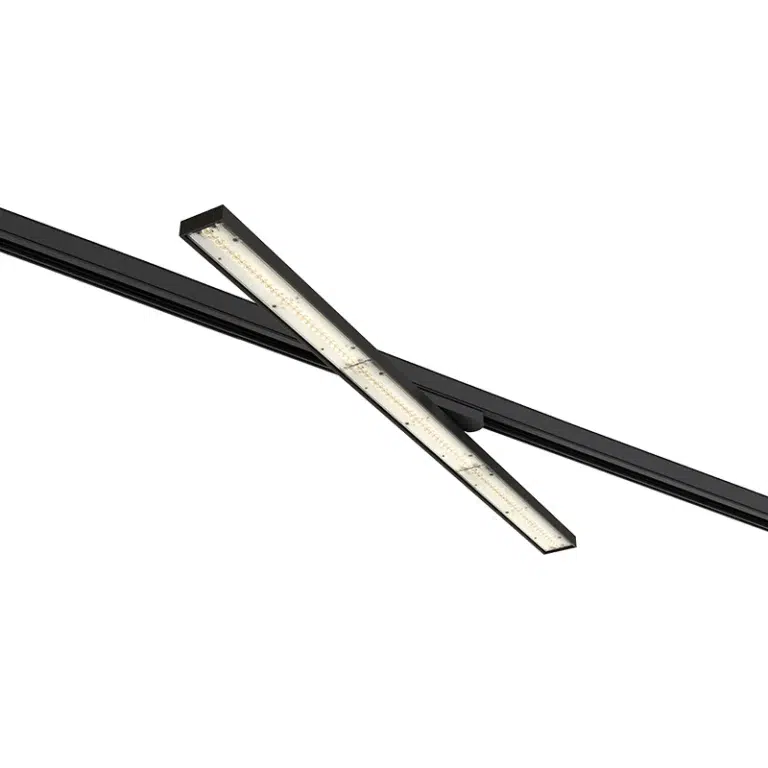
Slim linear modules (LINEAR L51) sit almost flush in recessed track, keeping the ceiling line clean.
The track sits in a slot cut or formed into the ceiling; only the channel opening and heads show.
Fördelar: the cleanest, most architectural result; heads sit protected inside the slot
Nackdelar: needs a planned slot and ceiling void, coordinated before ceilings close; hard to extend afterwards; trimless versions punish poor plastering
Bäst för: galleries, museums, hotels, flagship retail. If recessed track lighting is on the drawings, confirm slot dimensions and void depth with the ceiling contractor before ordering.
Monorail
A low-voltage rail, usually hand-bendable on site, held off the ceiling or wall on standoffs and fed through a transformer.
Fördelar: curves and free-form shapes follow the architecture; the rail itself is a design feature; heads are small and precise
Nackdelar: transformer capacity and voltage drop limit run length and head count; accent-level output only; high cost per metre
Bäst för: restaurants, hotel feature areas, reception counters. Monorail track lighting is feature lighting: specify it for the effect, and let another system do the work.
Bendable (flexible) track
Bendable track lighting keeps line-voltage track and standard heads, but the rail curves in the field to follow a wall or ceiling line.
Fördelar: follows curved architecture without custom-fabricated track, keeping a conventional system’s head choice
Nackdelar: minimum bending radius; curves and feed positions must be planned in advance; fewer matching accessories than straight track
Low-voltage track — commonly 48V — where heads attach magnetically and can be slid, swapped and re-aimed by hand, no tools, no adapter locking.
Fördelar: fastest reconfiguration of any track format; very slim profiles; suits current retail and hospitality design
Nackdelar: each brand’s magnetic geometry and contacts are proprietary — heads are not interchangeable between brands; higher cost per metre
Bäst för: boutiques, galleries, showrooms with frequently changing displays. It is a closed ecosystem: choose the head range as carefully as the track.
Four Decisions That Matter More Than the Track Itself
1. Ceiling conditions and project stage
Work backwards from the ceiling. A finished concrete slab with no void rules out recessed track. A suspended ceiling can take almost anything, if slots and feeds are coordinated early. In retrofits, surface track is usually the only format that does not reopen the ceiling — why it dominates rollouts. Check beams, sprinklers and AC runs before fixing track lines; track is unforgiving of clashes found on site.
2. Circuits and dimming
Circuit count is scene control. On single-circuit track, every head switches and dims together. Two- or three-circuit track (the 3-phase format in Europe) lets groups be controlled separately — window display, accent and general light on independent circuits — what makes scenes possible.
Dimming is decided by the driver, not the track. As a general guide: TRIAC suits simple retrofits with existing wall dimmers; 0-10V is a commercial standard; DALI is the choice when heads must be addressed individually or tied into a building management system. In-track driver designs keep ceilings clean — SUNME’s Tango series offers in-track TRIAC, 0-10V and DALI dimming options. Test the exact head-and-dimmer pairing before the bulk order: dimming incompatibility is the most common cause of flicker and call-backs.
3. Heads: beam angle, glare and colour
A zoom head (DUNK 80 ZOOM) adjusts its beam angle on site — useful when the display layout is not final at ordering time.
The track is infrastructure; the heads do the lighting. Three points decide the result:
Beam angle. Typical industry ranges: roughly 10–25° for accent work, 25–40° for general accent duty, wider floods for wall washing. Where display heights or distances change, zoom heads — such as the Dunk Zoom och Tango Zoom — avoid head swaps when merchandise moves; fixed-beam ranges such as the Dunk series cover standard duties.
Glare control. Deep-set optics, honeycomb louvres and good cut-off angles matter anywhere people linger — galleries, hospitality, premium retail. A glaring head gets dimmed or switched off, wasting the light you paid for.
Colour quality and format. For colour-critical retail and gallery work, specifiers typically set CRI 90 or above as a benchmark. Format is a maintenance decision too: lamp-based heads such as the Torus GU10 let clients source and replace lamps locally (output then depends on the lamp fitted); integrated-LED heads fix output at the factory. Linear heads — SUNME’s Linear series — add ambient wash on the same track.
4. Flexibility after handover
The entire point of track is change: tenants rotate, galleries re-hang, spaces get re-purposed. Specify for the second layout, not just the first — keep electrical headroom on each circuit, hold spare heads, and, for multi-site clients, standardise on one system across the estate so heads move between stores. A system that cannot change is just expensive fixed lighting.
Common Purchasing Mistakes
A purchase order that says “track light” without naming the system (H, J, L or 3-phase) or circuit count — how incompatible heads get produced.
Mixing heads and track from different brands because dimensions look close. Contact geometry, not channel width, decides compatibility.
Locking the head order before the dimming protocol is decided — changing protocol afterwards means changing heads.
Ordering recessed track for a ceiling with no void or slot allowance — discovered, expensively, at installation.
Forgetting accessories in the bill of materials — live-end feeds, connectors, corners, end caps. Small and cheap — and fully capable of stopping a site programme when missing.
No spare capacity. Circuits loaded to their limit and zero spare heads leave nothing for the first tenant change.
Vanliga frågor
Are H, J and L track heads interchangeable?
No. Contact position and geometry inside the channel differ between the systems, so a head built for one will not mount correctly — or will not make reliable contact — in another. Choose one system per project and state it in the order.
What is the difference between single-circuit and multi-circuit track?
On single-circuit track, all heads switch and dim together. Multi-circuit track (two- or three-circuit; 3-phase in Europe) splits heads into independently controlled groups — window, accent and general lighting as separate scenes on one track run.
Can commercial track lighting be dimmed with DALI?
Yes, when the heads and their drivers support it — dimming lives in the driver, not the track. Options run from TRIAC for simple jobs to 0-10V and DALI for project-level control, including in-track drivers that keep control gear inside the adapter. Confirm the exact pairing before ordering.
When should I choose recessed track lighting over surface track?
When the ceiling is being built or renovated anyway, and a flush, architectural finish justifies the extra coordination. For finished ceilings and tight budgets, surface track is the pragmatic choice.
How many heads can I put on one track run?
It is set by the circuit’s electrical rating and the wattage of the heads fitted. Add up the load, keep a margin for later additions, and have the project’s electrician confirm against local code.
The Bottom Line
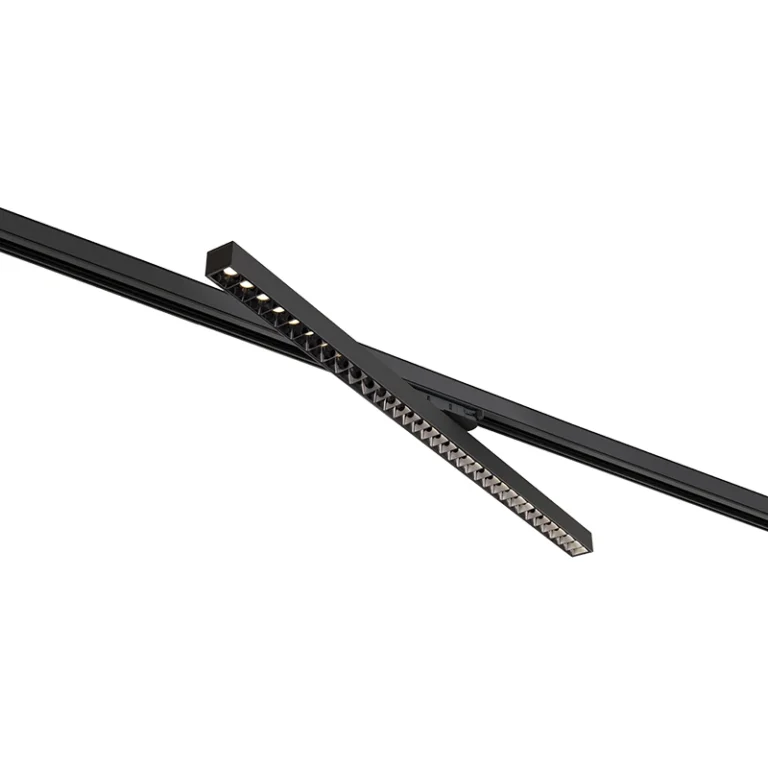
Anti-glare linear modules (LINEAR L33) wash shelves and walls evenly where spot heads would leave scallops.
In commercial track lighting, the expensive mistakes are compatibility mistakes: wrong standard, wrong circuit count, wrong driver. Get those three right and the system absorbs layout changes for years; get them wrong and no head will save the installation.
Planning a retail, gallery or hospitality project? Start from the system view: browse SUNME’s full track spotlight range — Clio, Dunk and Dunk Zoom, Tango and Tango Zoom, Torus Premium and the Linear series — and tell us the project type, ceiling build-up, track system and dimming protocol. We will help you assemble the combination that fits, with capacity left for the changes you know are coming.
Har du ingen e-postadress för ditt företag? Klicka här!






 English
 Deutsch
 Español
 Português
 Français
 Русский
 العربية
 Italiano
 Türkçe
 Suomi
 Svenska
 Magyar
 Nederlands